
The data behind the #LiveTCI Global Luxury Trends carousel — published as a standalone report.
Coldwell Banker Global Luxury’s 2026 Mid-Year Report tracks five trends defining the top of the world’s luxury property market right now, as reported by Inman (Cara Ameer, 4 August 2026). Set against Turks and Caicos’ own Q2 2026 numbers, four of the five aren’t abstractions here — they’re already the market.
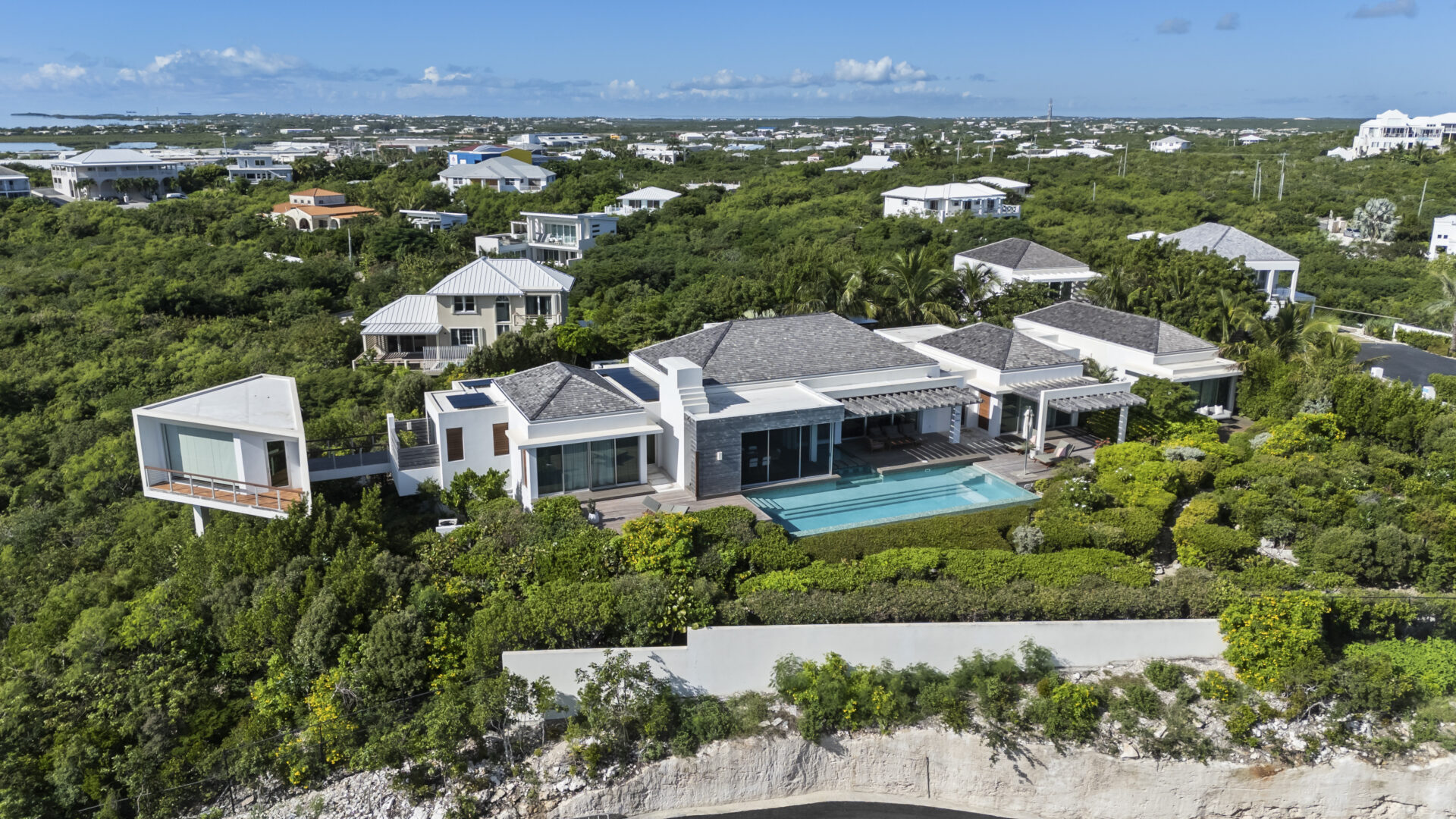
1. The Whole Island, Not Just the House
Globally, searches for large estates, castles and private islands rose 146% year-over-year — buyers aren’t just buying a house, they’re buying control of what surrounds it.
Turks and Caicos has a literal answer to that search. Ambergris Cay, at the remote southeastern edge of the archipelago, holds the longest private airstrip in the Caribbean — a 5,700-foot runway that puts a buyer from tarmac to villa in around twelve minutes. Over 60% of the island is held as nature reserve. Freehold villas and land lots are available to international buyers, with no property tax and no capital gains tax. It’s functionally the trend the Coldwell Banker report describes — not a concept here, an address.
2. International Capital Is Moving Again
Global luxury searches for U.S. property jumped 100% in the first five months of 2026, with New York, Florida and California drawing the heaviest interest.
TCI’s buyer base already looks like the destination end of that search pattern rather than the origin — across my own client relationships, that’s roughly 60–70% US, 15–20% Canadian, with a growing share from Central and South America and Europe. Airlift is expanding to match: six new nonstop US routes launch over the next year, alongside new Denver and Atlanta services, plus a 19% increase in Canadian winter airlift. Easier to reach, tends to precede easier to buy.
3. Real Estate as the Wealth Strategy
Coldwell Banker frames 2026 luxury buying as capital parking as much as lifestyle spending — the top 10% of the single-family home sector across 120 US markets added $3.7 billion in dollar volume year-over-year.
TCI’s tax structure is the plainest version of that same case available anywhere in the Caribbean: no annual property tax, no capital gains tax, no income tax on locally-earned rental revenue, and no inheritance tax. The only tax event is stamp duty at purchase — 10% on transactions above US$500,000. For a buyer already thinking about real estate as somewhere to park and grow capital rather than simply live in, that’s a materially different cost base than almost any US market it’s being compared against.
4. Liquidity Is Concentrating at the Top
The top 1–5% of luxury buyers are now fuelling nearly 60% of the market’s growth, and cash is doing the buying — in Orange County, California, roughly half of all $5M+ transactions in the past three months closed in cash.
TCI’s own Q2 2026 figures show the same pattern in miniature. While the broader market recalibrated — sales volume down to $62.25M across 65 transactions, well off the 2023 quarterly peak — single-family home sales above $5M held exactly steady at 2 transactions, matching Q2 2025. Turks & Caicos Sotheby’s International Realty’s own Q2 report goes further: conditional activity has now surfaced in the above-$20M segment, with $8.75M under contract and $7.8M sold in H1 2026 — the clearest signal yet that top-of-market capital is re-entering. TCI doesn’t publish a cash-versus-financed split, but the market’s own financing structure points the same direction: local lenders cap foreign-buyer mortgages at 50–60% loan-to-value, with heavy documentation requirements many non-residents can’t or won’t meet — meaning most luxury and ultra-luxury purchases here are cash by necessity as much as by preference.
5. Turnkey Inventory Is the Scarce Asset
Move-in-ready luxury homes are drawing multiple offers and closing well above ask globally — a turnkey Orange County property recently sold $1 million over asking within days of listing.
TCI’s version of the same scarcity shows up at the very top of its own sales ladder: Providenciales single-family homes sold for $30M in 2024 and $34.2M in 2025, and a 7-acre oceanfront estate — extensively rebuilt since a 2019 purchase — went to a no-reserve auction this April with a $50M ask. Broader inventory has genuinely expanded (912 active listings in August, more than double 2022), but true move-in-ready product at the top of the market remains the asset buyers compete for, not the one they can afford to wait out.
What This Means for Buyers
Four of Coldwell Banker’s five 2026 trends aren’t a forecast for Turks and Caicos — they’re already reflected in this quarter’s numbers, while the broader market gives buyers more genuine choice and negotiating room than at any point since 2022. The exception is turnkey scarcity, and even there, TCI’s ultra-luxury sales ladder is intact and climbing. For a buyer already reading the Coldwell Banker report and wondering where else this thesis plays out, Turks and Caicos isn’t a contrarian answer. It’s already showing the same numbers.
Sources: Trend data from Coldwell Banker Global Luxury’s 2026 Mid-Year Report, as reported by Inman (Cara Ameer, 4 August 2026). Turks and Caicos figures from the TCREA Q2 2026 Statistics Summary Report (30 June 2026), Turks & Caicos Sotheby’s International Realty’s Q2 2026 YTD Comparison Market Report, and liveTCI’s own islands and market-conditions research. Financing terms per published TCI real estate guidance (Chambers and Partners Global Practice Guide; Jarnias Cyril). This piece is for general market information only and is not investment, legal, or tax advice — buyers with US or Canadian tax residency should consult a qualified international tax adviser regarding their specific circumstances.
Simon Ferrand — liveTCI Real Estate. Email sales@livetci.com.